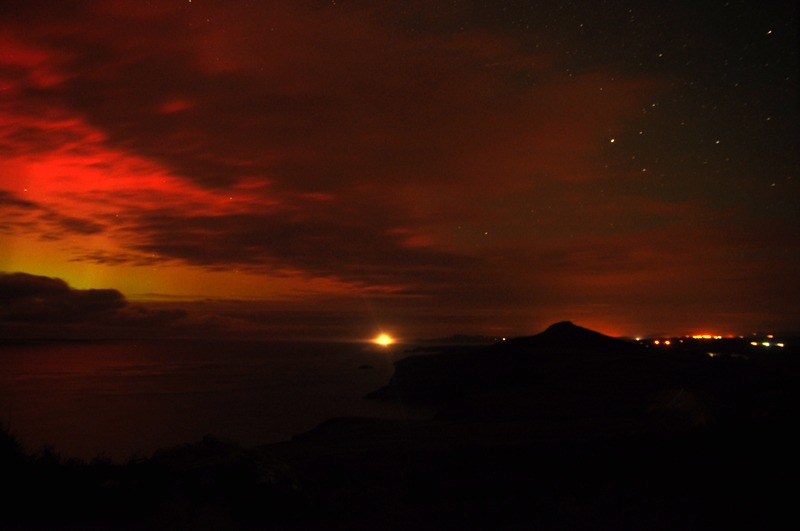
This is the final section of my Earth to Earth film capturing the aurora borealis.
24th October 2011.
Location: Carn Treliwyd, Pembrokeshire, Wales – 51° 54 N 5° 16 W
Aspect: Looking North East towards Strumble Head along the North Pembrokeshire coast.
The starting point for this idea comes from my degree in Archaeology and Anthropology. One strong rhetoric within archaeology is that the placing of standing stones, the burial of the dead and building of monuments all has strong associations with the surrounding landscape. The location of these is seen as a veneration of the landscape and nature and it is this concept that I am particularly interested in.

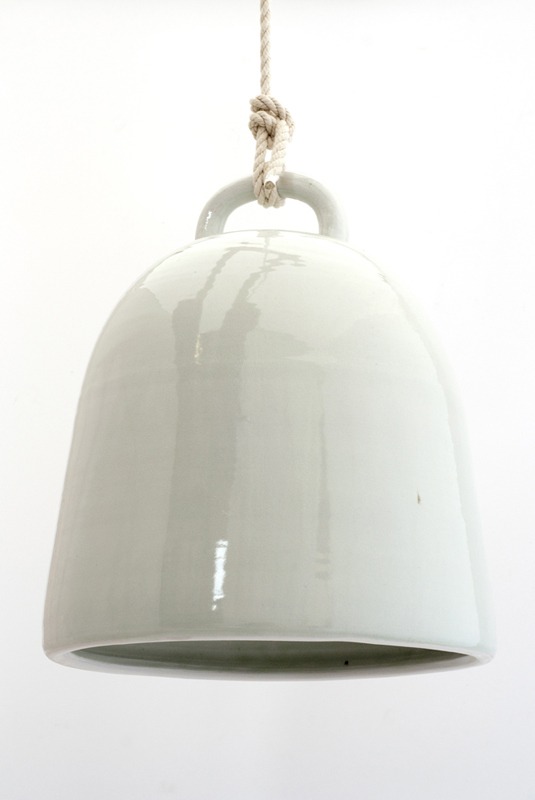
I wanted to place an object in a beautiful location in the hope that it would draw attention to its surroundings, as a homage to nature. I see bells as a universal symbol of the sacred and an ideal choice for this.


As this concept developed, I have discovered three things that captured my imagination:
In Meissen, Germany, famous for its porcelain, Paul Börner made porcelain bells for the cathedral up to 50cm in height. Thought by some to be a masterpiece.
Secondly, that across the world, past and present single resonant stones or rock gongs, are used as a substitute for bells. The local village of Maenclochog – meaning ringing stone has in the surrounding area prehistoric sounding rocks.
Finally, another local legend. In a tiny chapel built into the sea cliffs of Pembrokeshire St.Govan had a silver bell. Stolen by pirates, it was returned to him by angels and encased in a huge rock, which would ring if struck. Legend has it that the rock is still among the boulders on the foreshore at St.Govans


N.B. The bell was only hung while I documented it hanging in the cave entrance. It appears this has been misunderstood by some and has been seen as intrusive to the natural environment. Had I left it there, I would agree.
Here is a preview of the time lapse film I have been making to document my Land Art project Earth to Earth. Full version coming soon…

Seven days of waiting and watching every change in the weather and this is what I found on Sunday morning. 20,000 images and the disintegration of the Jar happened in the dead of night, unable to be seen by the camera. The footage is amazing but what an anticlimax to have missed the defining moment of the process. I will try again.


What makes ceramics unique as an art form is the transformative process of firing. You make the work and then give it to the fire and hope that during its metamorphosis something beyond your expectation emerges. It is a natural process. No two trees grow the same and no two pots emerge the same. I take clay from the earth, process it, humanise it and form it. I then give it back to the elements, to fire. This naturalises it again giving it its own individual character, something uncontrolled by me.

Placing your work in a kiln, relinquishing control of its final aesthetic takes a certain mind set, patience and a certain amount of faith. Placing a jar on a hill to weather away is a similar process. I am still committing the jar to the elements, air and water instead of fire and there is still a transformation. 


For the past two months I have been working on the Earth to Earth project. This is part of my Arts Council of Wales research grant. This time I decided to document the weathering of the Jar using Time Lapse Photography. At first I thought this would be straight forward but the more I thought about it the more involved the project became. Firstly I needed a way to house the camera that was weather proof. I ended up modifying an electrical junction box. I knew from the experience of past attempts that the Jar would last anything from a few days to two weeks so I needed to power the camera for a long period. I used a 12v battery and a DC to DC power converter. Just getting this far took a lot of research and technical knowledge for which I am very grateful to Colin Gregory.

The Jar will be photographed day and night every 33 seconds until it has weathered away. Each shot will become a single frame in a film with 25 frames per second. The camera will take 109 pictures and hour which will translate to just over 4 seconds of film. For this I had to work out all the best camera settings, the interval between shots, the aperture, the shutter speed, the ISO and so on. More technical research and long conversations with my brother Greg. As a teenager I had a manual SLR camera and that foundation in understanding cameras really paid off.

Last week I did a trial run, at first I thought it wouldn’t be, but I soon realised despite all my research I still had a lot to get right. The results however from the trial are very encouraging and exciting. The changing weather, the stars at night, moon light, sun rise, rain all captured on camera.

This project has been a journey in its self and I have been contemplating for a long time how best to illustrate it. I am hopeful that this will be an interesting depiction. I have never exhibited this project in any capacity and just recently I have had interest in it from a number of places. Most excitingly I have been asked to be part of a major exhibition at Ruthin Craft Centre in January and they are particularly interested in exhibiting this piece. Lets hope it goes well.

This autumn, the V&A and Crafts Council will celebrate the role of making in our lives by presenting an eclectic selection of over 100 exquisitely crafted objects. As part of this major exhibition entitled ‘Power of Making’ people from around the world were invited to upload short films about making and a selection of the best entries will be continually screened in the exhibition. This film by Greg Rodland Buick, of me throwing a large Moon Jar was selected. It is so great to have such a talented photographer and now film maker as a brother.
I have used seaweed in my work for some time, laying it directly onto the surface of pots during firing. For years I have been meaning to test its use as a glaze component. Wood ash is commonly used in glazes as is other organic matter, I have only ever seen one reference to seaweed ash. It took a sack full of seaweed to make a handful of ash, enough for a few tests.


It is so rewarding using raw materials from my surroundings. I am often struck by the subtlety of the materials and how they exude there location. These tests with seaweed ash definitely have a sense of the atlantic about them. Every raw material that I collect has a unique quality, a strength of character that prevails through the extreme metamorphic processes of the firing.


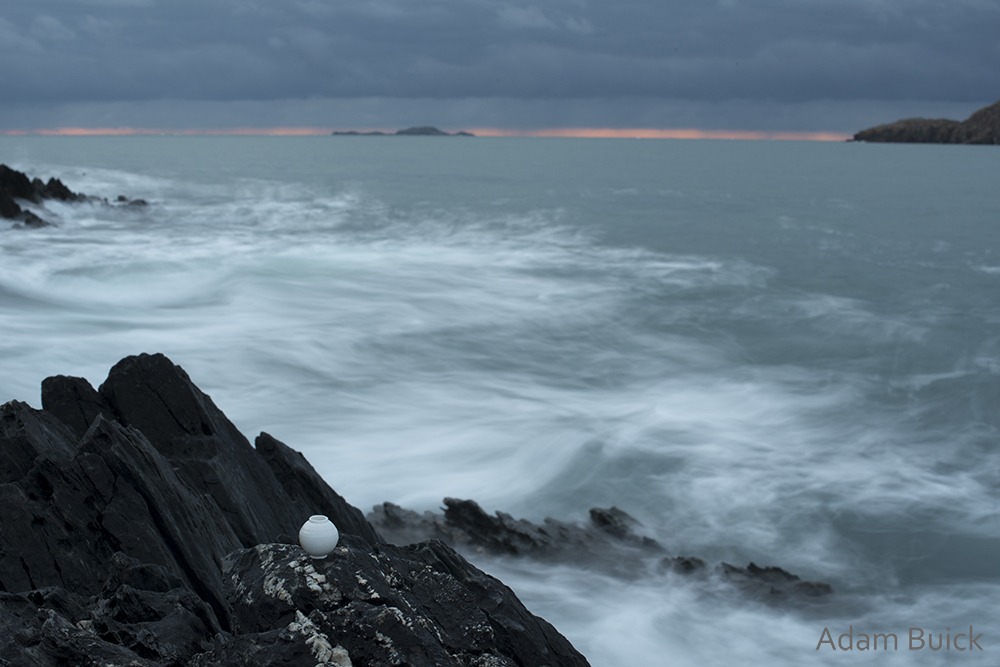
I left a Votive Jar among the kelps and Worts, which have been such a rich and important resource for thousands of years.


Just over six weeks to make a kiln full of work for this years kiln opening, the main event at my annual Open Studio.
I have been reading through some of my old Archaeological literature from my time at university and have come across some interesting concepts. One area that particularly caught my interest is the burial or deposit of objects within the landscape by the people of the Neolithic. Human bones, animal bones, tools and even pottery were deliberately placed in locations that had significance to those people at that point in prehistory. Many of the locations appear to be determined by landscape features almost an exploration of their relationship to nature and the land. These structured deposits are partly about the objects but also about a place. Most “votive deposits” are in well used locations, tombs or settlements, some however are in wild places.

Part of my work is about an exploration of our relationship to nature and the land. I have therefore made a series of tiny Jars about 15mm high to deposit in the landscape at places that I draw on for my work. I have been out a lot recently collecting new materials and exploring the local landscape as part of my research. I have left a few Votive Jars.